With the November elections approaching and competitive races for governor and U.S. Senate, Austin residents reflect on the possibility of political change and what it could mean for Texas’ future.
Austin resident Tom Ramsey believes Texas could elect Democrats to statewide office this November.
But he isn’t convinced it will.
“Personally, I do believe that Texas can flip blue this November, but I am cautiously skeptical about it rather than cautiously optimistic,” Ramsey said.
For Ramsey, the possibility of a political shift has less to do with growing Democratic support than with dissatisfaction among some Republican voters.
“It seems like a good number of Texas Republicans do not want to see Ken Paxton in office, but the only issue with that is that the same Texas Republicans likely do not want to see James Talarico in office either,” Ramsey said.
According to an Oct. 13 University of Texas/Texas Politics Project poll conducted Sept. 25 to Oct. 5, Talarico leads Paxton 50% to 47% among likely voters. In the governor’s race, Democratic state Rep. Gina Hinojosa leads Republican incumbent Greg Abbott 49% to 48%.
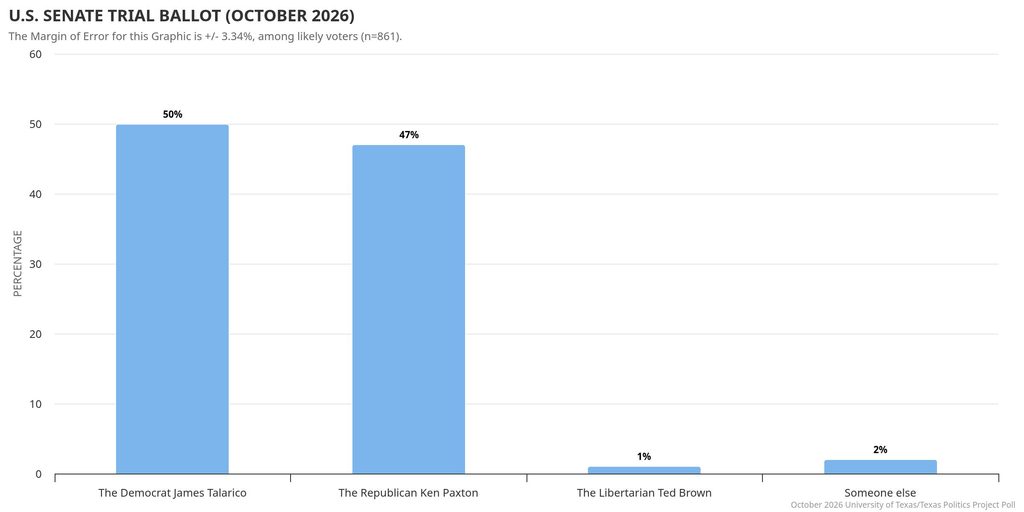
Both differences fall within the poll’s 3.34-percentage-point margin of error, leaving the races statistically too close to call.
The findings suggest an unusually competitive election in a state that has long been considered reliably Republican, with the party dominating statewide elections for more than three decades.
“I think the opportunity for Texas to flip blue is here and the time is now, but at best it’s a level playing field,” Ramsey said.
He hopes the next generation of state leadership will place greater emphasis on separating church and state, particularly in public education.
“As someone who is not religious, it is hard to see such an emphasis put on the religious views of political candidates,” Ramsey said. “I believe this specific example represents a much larger overarching view of protecting the rights of the individual rather than the imposition of the state’s beliefs.”
For Austin resident Sabrina Solari, the election represents an opportunity to address the rising cost of everyday life.
Gasoline, groceries, wages and health care are among her biggest concerns.
“I think that everybody deserves a fair chance at stability no matter what they do,” she said.
She also said lowering inflation is one of the changes she would most like to see in Texas. She wants higher minimum wages and greater access to affordable medical care.
Without health insurance herself, she often faces the difficult decision of whether to pay out of pocket for routine medical appointments.
“It’s really not realistically sustainable,” Solari said.
She also wants changes to the state’s abortion restrictions, greater protections for women and stronger gun safety measures.
For Solari, the issues are personal. But she believes younger Texans are becoming increasingly aware of how political decisions affect their lives.
She credits social media with making political information more accessible to younger generations and believes Talarico and Hinojosa have recognized the importance of reaching voters through platforms such as TikTok and Instagram.
Solari appreciates what she sees as their willingness to engage directly with criticism and answer difficult questions.
Her concerns are shared by Texans across the political spectrum.
The UT poll found that 36% of responses to an open-ended question about voters’ most important election issue focused on the cost of living or the economy. Economic concerns were the most frequently mentioned issue among Republicans, Democrats and independents alike.
But shared concerns do not necessarily mean shared political preferences.
The poll found that Republicans maintained narrow leads in generic congressional and state legislative races, even as individual Democratic candidates polled competitively.
Austin has its own connection to the race for governor.
Before running for statewide office, Gina Hinojosa spent years representing the city through its public schools and the Texas Legislature.
That history is part of what makes her campaign particularly relevant to the Austin Chronicle, an independent publication that has covered the city’s politics and culture for more than four decades.
In an Oct. 15 feature titled “Can Gina Hinojosa Flip Texas?”, Chronicle reporter Sammie Seamon interviewed Hinojosa about her campaign and the concerns she has encountered traveling across the state.
“I am hearing that people want change,” Hinojosa told the Chronicle.
Before representing Austin in the Texas House, Hinojosa served on the Austin ISD school board from 2012 to 2016, including a term as president.
Her campaign for governor has emphasized public education, affordability and limiting corporate influence in state politics.
Hinojosa believes those concerns extend beyond party affiliation.
“Those are not Democratic or Republican issues,” Hinojosa told the Chronicle. “I do think people are tired of fighting culture wars.”
Her campaign faces considerable challenges.
Abbott defeated Democratic challenger Beto O’Rourke by 10.9 percentage points in 2022 and has maintained a substantial fundraising advantage throughout much of the current election cycle.
Still, the Chronicle reported that Hinojosa’s campaign had raised more than $25 million by early October, reflecting increased financial support as November approaches.
The publication also interviewed state Rep. Christian Manuel, a Democrat representing part of East Texas, who described encountering traditionally Republican voters reconsidering their choices.
“The pendulum always swings,” Manuel said.
That possibility is particularly significant outside cities such as Austin.
The UT poll found that rural likely voters preferred Abbott over Hinojosa 68% to 28%, while urban voters supported Hinojosa 56% to 42%.
For Austin resident Riley Endsley, the divide is visible even without polling numbers.
Driving through her neighborhood, she has noticed campaign signs supporting Hinojosa and Talarico.
But she recognizes that the political attitudes surrounding her may not reflect those of Texans elsewhere.
“Yes, I’m hopeful, but I feel like I’ve been hopeful so many times and I’ve been let down,” Endsley said. “So it’s hard to be hopeful.”
A master’s student studying environmental health at Johns Hopkins University, Endsley is especially concerned about what the election could mean for Texas’ environmental future.
She believes a change in leadership could create opportunities for stronger environmental protections and different approaches to development.
But reversing existing damage would be difficult.
“A lot of damage has been done, and it’s hard to come back from that when forests have been torn down and urbanization has occurred,” Endsley said.
Endsley has watched other states implement environmental policies she hopes Texas might eventually consider. Still, she recognizes that political change does not automatically mean environmental progress.
“I think there’s a potential for it to get better,” she said.
For Ramsey, Solari and Endsley, the election is about more than whether Texas turns blue. It is about the rights people have, the lives they can afford to build and the future of the state they call home.
But even if November brings a change in leadership, the concerns shaping this election will not disappear overnight.
Texas has seen the possibility of political change before.
What remains uncertain is whether this time will be different.
Leave a Reply